

Opening A Roastery: Chapter One
Municipal Commandments and Zoning Misadventures

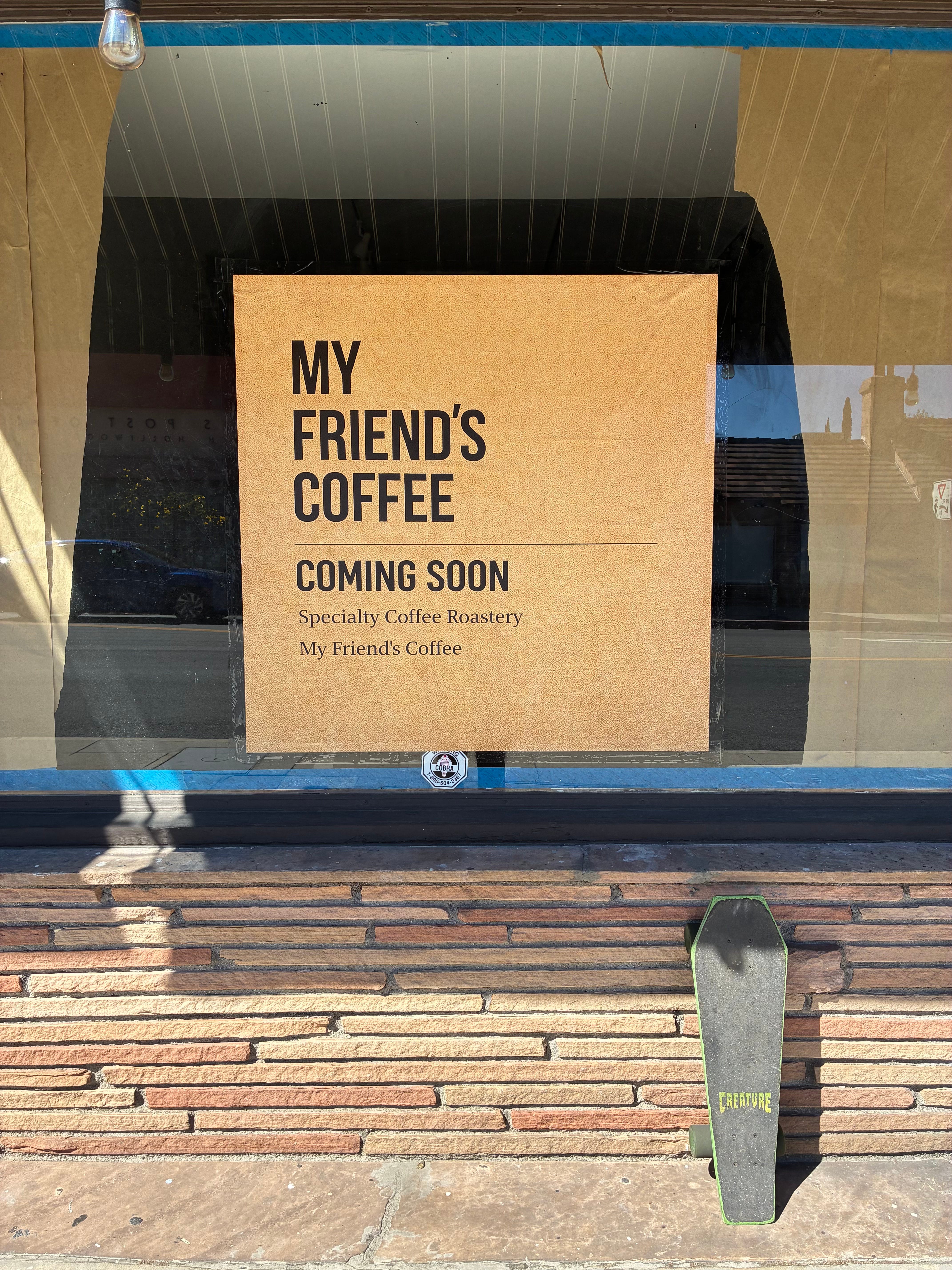
This is the first post in a series titled “Opening a Roastery.” My hope is to offer a behind-the-scenes look at the creation of the new My Friend’s Coffee Roastery and Shop. Rewards of readership include answers to questions like, “Why are there so few shops that roast in Los Angeles?” and “Why doesn’t this Substack have more followers?” With any luck, it will be a David Copperfield opus and a seminal work in the Small Business Thriller genre.
Chapter One: Zoning
My decision to open a brick and mortar involved two non-negotiables:
The coffee had to be roasted on site.
The location had to be accessible to customers.
Those things, it turns out, are as fraught with challenge as a Tom Hanks lunar expedition.
You may have noticed that there aren’t many LA shops with coffee roasters in them. That’s because the city has guidelines that make creating one a quixotic exercise in self-punishment. The first of its commandments?
Thou Shalt Obey The Zoning Map.
LA’s zoning map is the world’s least attractive jigsaw puzzle, a Halloween skeleton of squiggles and shades that fits the landscape like skinny jeans on a competitive eater. Overzealous readers—without friends or meaningful ways to pass time—can view it at the city’s online zoning portal, ZIMAS. “ZIMAS?” you ask. “Is that an acronym? A nod to bygone wine coolers?” I suspect yes to both, but mostly it’s a demonstration of LA’s aptitude for the byzantine.
Let’s start with the M zone, which, in case you’re wondering, stands for Manufacturing. This is where the big noisy, industrial type businesses are supposed to set up shop. Sounds straight-forward enough, right?
Not exactly.
You see, the M zone isn’t so much one designation as it is a late-stage Jenga tower, primed to collapse into tabletop rubble. Sift through the rubble, and you’ll find its component parts: M1, M2, and M3. You might think these subdivisions are the end of the line—au contraire. Just as M can be reduced into M1, M2, and M3, so can M1, M2, and M3 be reduced into M1.5, M2.5, and M3.5.
If you’re the type of person who regards subatomic particles as evidence of a higher power, you’re sure to find spiritual satisfaction in these zoning protons and neutrons. They’re every bit as mystifying as quantum physics, and, like the Pyramids or Stonehenge, it bends the mind to think that humans created them. But let’s not get mired in a metaphysical morass—back to the nuts and bolts of opening a coffee roastery.
The good folks at the city consider coffee roasting a manufacturing activity. Hence, if you plan to fire a drum, you’d better be in an M zone. But for the artisan entrepreneur, M zones are problematic because they sit in desolate stretches on the outskirts of town, the kinds of places where you’re likely to flip coins with Anton Chigurh. The city’s thinking here is logical: roasting entails noise and emissions, and those things belong far from where people live.
But a nano roastery ain’t Starbucks. It creates fewer emissions than a neighborhood BBQ joint and runs quieter than a local gym. Forcing a craft business into a hangar-sized outfit on the edge of civilization is lunacy. Luckily, the city allows exceptions to its rules, and the wise nano-roaster—an oxymoronic term to be sure—will appeal to the powers that be for a one-way ticket to the C zone.
The C zone stands for Commercial. It is designed for retail and restaurants and all manner of niche ventures. You can set up a cafe in a C zone; you can also set up a coffee shop (bizarrely, the city draws a distinction between these two things). The C zone, in other words, allows you to open precisely the type of business that you want—right up until that business includes a coffee roaster. The moment a whirring mass of hot beans enters the picture, cumulus clouds gather, the sky strobes, and old folks on porches the world over mutter that a storm’s a-coming. At this point, savvy entrepreneurs run; dull ones strap themselves to a mast. I land in the latter category.
Given the niche nature of my business and its strong customer-facing aspect, I was determined to open in a C zone. After much hunting, I landed on a space in Valley Village, a stone’s throw from Studio City. It was quaint, neighborhoody, big enough to accommodate my needs, not so big as to slap me with unbearable costs—damn near perfect. So, I reached out to the Department of Building and Safety to confirm that I could roast there, and that’s when things got strange.
I’m going to pause here for a moment to point out a truth that ought to be obvious: a yes or no question can yield only two responses: yes or no. But stunningly, stupendously, stupefyingly, the Department of Building and Safety managed to supply not two, but three different answers,
Yes. No. And yes and no at the same time.
Every time I called I got a different representative, and every representative gave me a different answer. Their word seemed about as reliable as a crypto currency called Crypt Keeper’s Delight. There was simply no way to move forward, no way to sign a lease, no way to start building a shop without an assurance that I could, in fact, use that shop. I was caught in enterpreunerial purgatory, and it was maddening to the bone.
Despair settled in. Hope dwindled. I ate lots of carbs. But then a narrative twist surfaced—as such twists often do—in the least likely of ways.
To be continued…
I love a good cliffhanger!!!!! 😳🤣